ling-miao
↓ 0 downloadsmiao: a Ling-native version control system — temples, souls, rites and talismans instead of repos, branches, commits and tags; adaptive whole/delta/chunk storage; SSH temple fairs for sharing; a LingStationX-themed GUI; ROYGBIV everywhere
lingfu install ling-miaoREADME
miao 庙 — the temple of versions
A version control system written in the Ling language, with its lexicon drawn from ling 灵 — the numinous — in Chinese religion. Where git has repos, branches, commits and tags, miao has temples, souls, rites and talismans; where git clones, pulls and pushes, miao practices spirit division (分灵), pilgrimage (进香) and tribute (回香) — the actual vocabulary of how temple networks spread efficacy in the real world. It does diffs, branches, three-way merges, content-addressed storage, and secure repo sharing over real SSH. Everything is ROYGBIV.
One codebase gives you:
- a CLI (
miao.bat/miao.sh) with truecolor rainbow output, - a GUI — LingMiao, in the LingStationX / LingDev design system,
- a LingOS edition — the traveling shrine built into
lsh, plus a zsh-style ROYGBIV prompt that shows your soul and altar the way zsh shows a git branch.
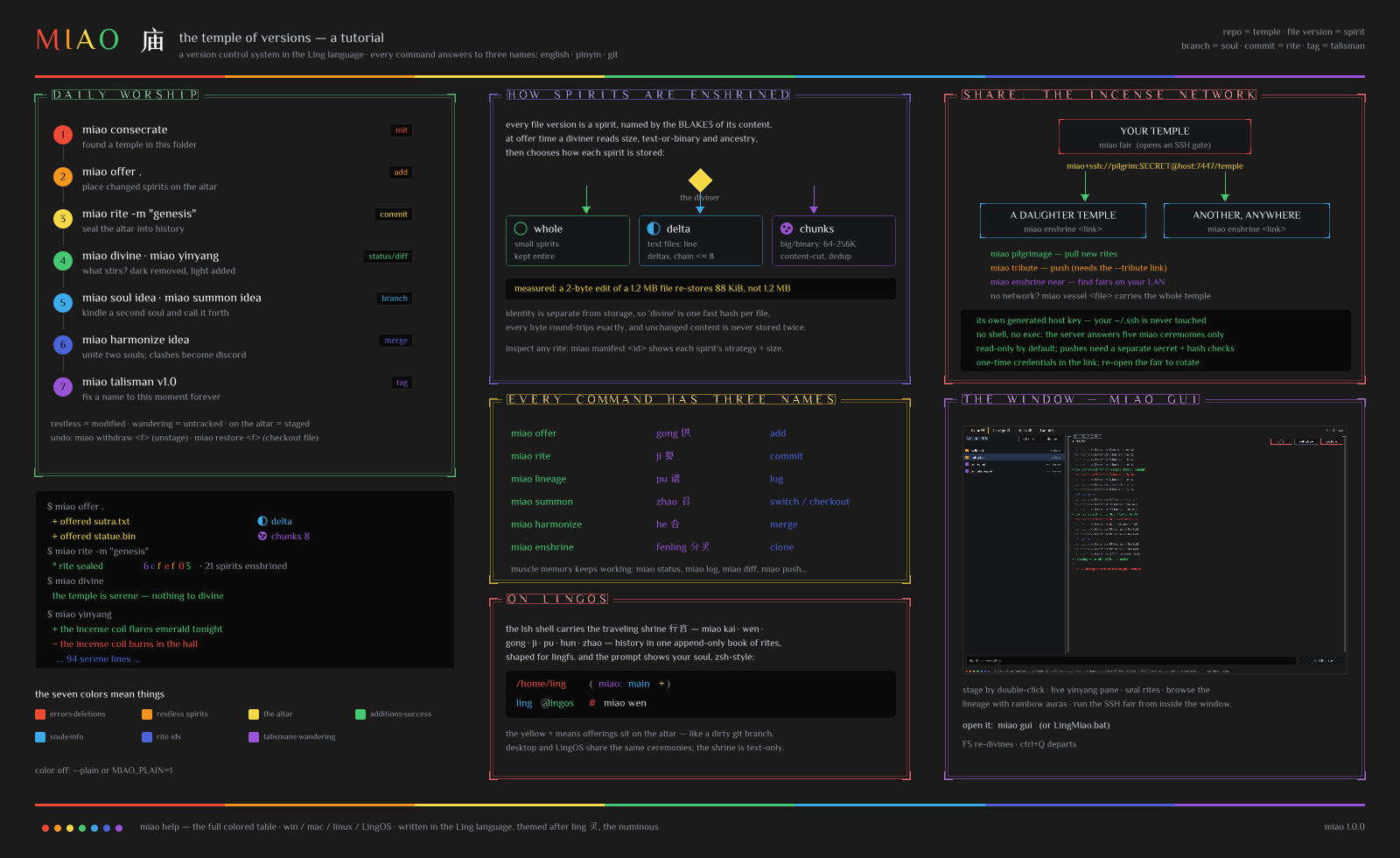
The tutorial poster above is drawn by miao's own design system — regenerate it any time with ling run --interp tools/infographic.ling.
The cosmology
A repository is a temple (.miao/). Every version of every file is a spirit, named by the BLAKE3 hash of its content. Staging is an altar; committing seals a rite; branches are the temple's souls (HEAD is the living soul); tags are talismans. Untracked files are wandering spirits, modified files are restless, merge conflicts are discord.
Every command answers to three names — english · pinyin · git:
| command | pinyin | git | what it does |
|---|---|---|---|
miao consecrate [dir] | kai 开光 | init | found a temple |
miao divine | wen 问 | status | ask the oracle what changed |
miao offer <paths|.> | gong 供 | add | place spirits on the altar |
miao withdraw <paths> | che 撤 | unstage | take an offering back |
miao rite -m "..." | ji 祭 | commit | seal the altar into history |
miao lineage [-n N] [--all] | pu 谱 | log | the genealogy of rites |
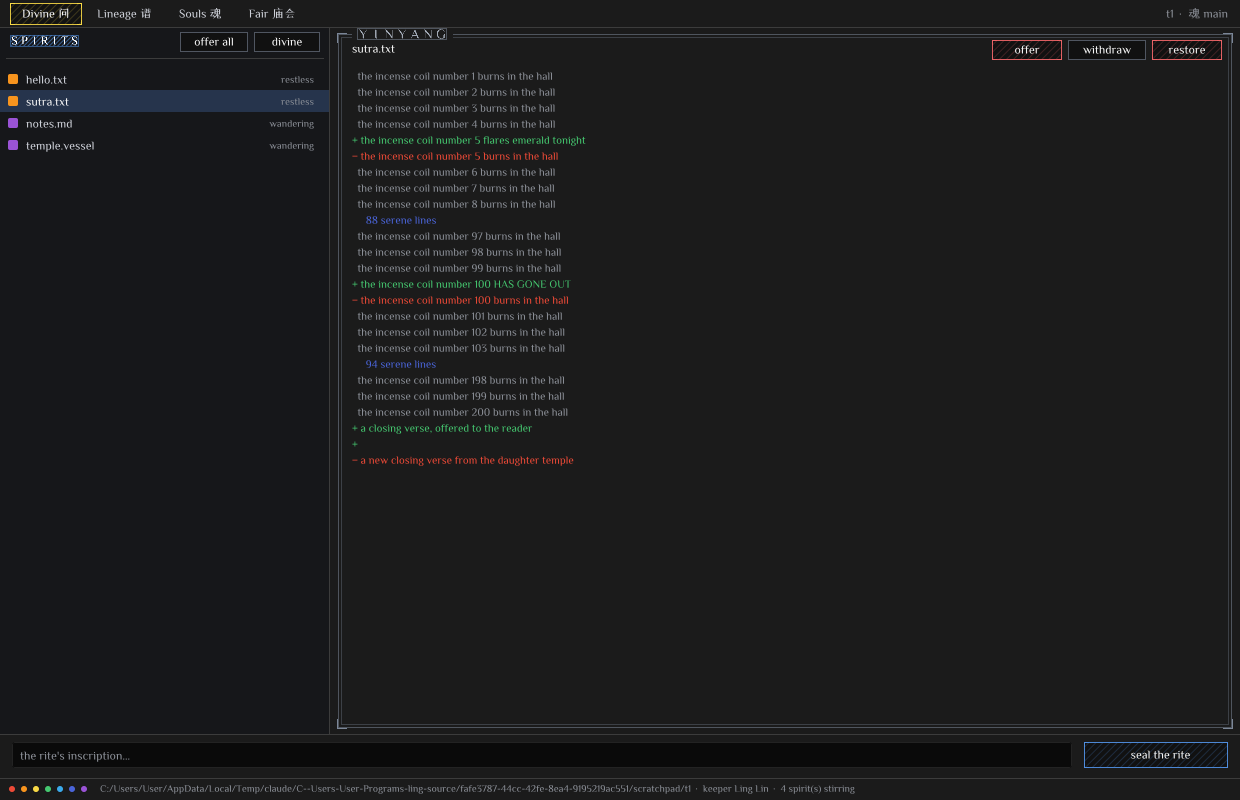
miao yinyang [a] [b] [--altar] | 阴阳 | diff | dark removed · light added |
miao soul [name] [-d name] | hun 魂 | branch | the temple's souls |
miao summon <soul|rite> | zhao 召 | switch / checkout | call a soul into the worktree |
miao harmonize <soul> | he 合 | merge | bring two souls into harmony |
miao talisman [name] [rite] | fu 符 | tag | fix a name to a moment |
miao manifest [rite|path] | xian 显 | show | let a spirit manifest |
miao restore <paths> | huan 还 | restore | return a file to its enshrined form |
miao fair [--tribute] [--port N] | hui 庙会 | serve | open your temple over SSH |
miao enshrine <link|near> [dir] | fenling 分灵 | clone | found a daughter temple |
miao mother [add n link | rm n] | zumiao 祖庙 | remote | the ancestral temples you follow |
miao pilgrimage [mother] | jinxiang 进香 | pull | fetch + fast-forward |
miao tribute [mother] | huixiang 回香 | push | carry your rites up |
miao vessel <file> [--open] | 法器 | bundle | the whole temple in one file |
miao keeper [name] | 守庙人 | config | who signs your rites |
miao chronicle | 编年 | reflog | what the temple remembers doing |
miao gui | open the LingMiao window |
miao help prints this in color. --plain or MIAO_PLAIN=1 silences the rainbow.
Quickstart
cd my-project
miao consecrate
miao offer .
miao rite -m "genesis"
miao soul feature && miao summon feature     # branch & switch
...edit...
miao yinyang                                 # colored diff
miao offer . && miao rite -m "the work"
miao summon main && miao harmonize feature # merge (conflicts become discord)Adaptive versioning — the diviner
miao does not store every version the same way. At offer time a diviner inspects each file — size, text-or-binary (by UTF-8 validity, not extension), its previous incarnation, the delta chain depth — and chooses an enshrinement per spirit:
| strategy | glyph | chosen for | how it works |
|---|---|---|---|
| whole | ○ | small spirits (≤ 256 KiB), first versions | full content, stored raw |
| delta | ◐ | text files with a previous version | a line-delta script against the prior spirit; chains are capped at depth 8 and fall back to whole when the script wouldn't save ≥ 55%, so summoning stays O(1)-ish |
| chunks 分身 | ◍ | large files (> 256 KiB), binaries | content-defined chunking (anchor-based, 64–256 KiB chunks): chunks dedup across versions and across files |
Identity is separate from representation: a spirit's name is always the BLAKE3 of its full content (so divine is one fast hash per file), while how it is stored lives in a small manifest. Measured on this machine: a 2-byte edit to a 1.2 MB binary re-stored 88 KiB, not 1.2 MB; a 1-line edit to a 200-line file stored a ~60-byte delta. Bytes are exact on the way back out — binary round-trips are hash-verified in tests.
Sharing: the temple fair (real SSH)
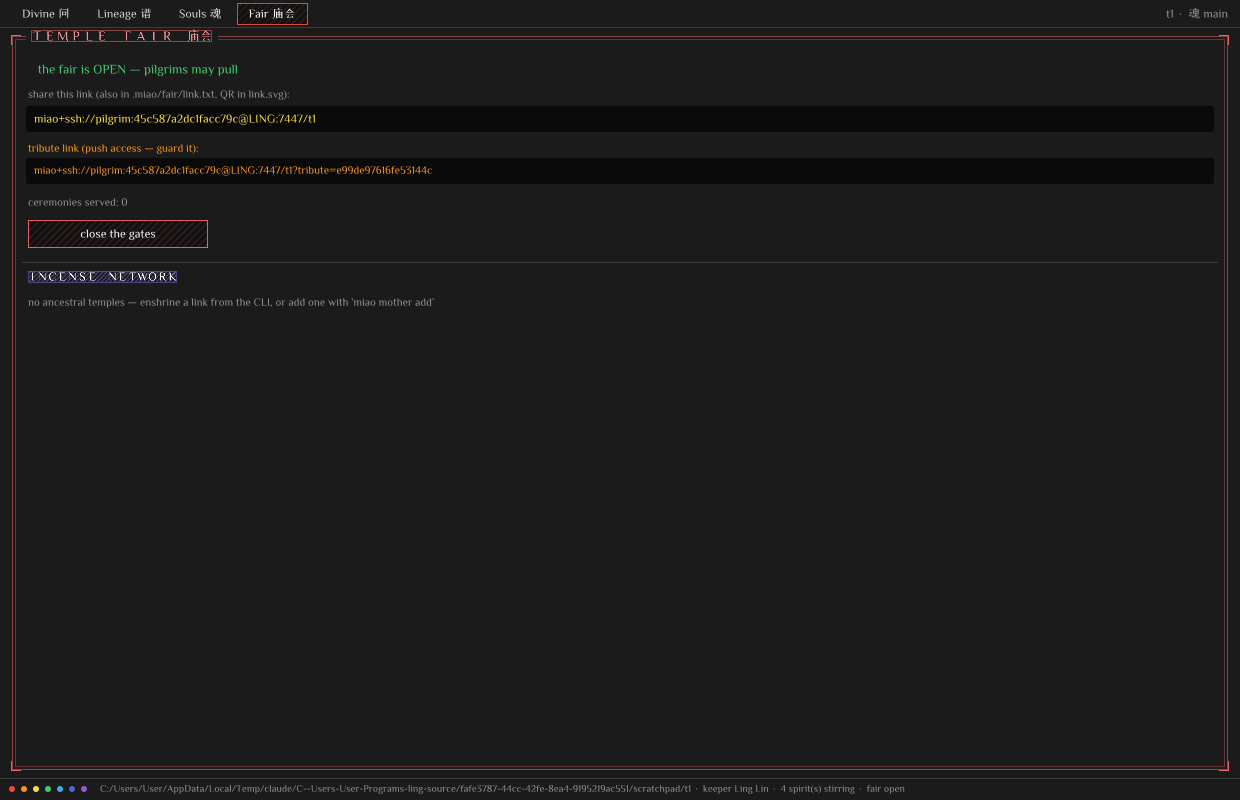
miao fair                 # read-only; prints a link like
                          #   miao+ssh://pilgrim:SECRET@yourhost:7447/temple
miao fair --tribute       # also prints a second link whose holders may push
miao fair runs a real SSH server (russh, built into the Ling runtime) with:
- its own generated host key under
.miao/fair/— your personal SSH keys are never read, never served, never at risk; - one-time credentials baked into the link (fresh every fair);
- no shell, no exec, no filesystem — the server answers only the five MIAO protocol ceremonies (HELLO / BUNDLE / SINCE / TRIBUTE / nothing else), so a link-holder can take a copy of the repo and nothing more;
- read-only by default — pushes need the separate
--tributesecret, are hash-verified object by object, and only ever fast-forward souls; - a QR code of the link in
.miao/fair/link.svg, and a LAN beacon — nearby friends can runmiao enshrine nearto discover your fair (the beacon carries no secret).
Collaborators then:
miao enshrine "miao+ssh://pilgrim:SECRET@host:7447/temple"   # clone
miao pilgrimage                                              # pull (ff or “diverged — harmonize”)
miao tribute # push (entrusted seal, or tribute link)Selecting who may push: the keeper's seal 印
Instead of (or alongside) the shared --tribute link, you can grant push rights to chosen people, each by their own Ed25519 identity:
# the collaborator, once per machine:
miao seal                       # cuts a personal seal, prints its 64-hex "seal print"

# you, in your temple:
miao entrust ming <seal print>  # select them
miao entrust                    # list the entrusted
miao entrust --revoke ming      # withdraw (takes effect immediately, even mid-fair)
From then on miao tribute from ming signs the bundle with their seal, and your fair accepts it even in read-only mode — no push secret ever travels or gets shared. The server verifies the signature over the bundle hash and the temple name, checks the seal against .miao/entrusted live on every request, applies objects hash-verified and fast-forward-only, and the chronicle records who pushed (tribute-from ming). Private keys never leave the Ling runtime; only a seed sits in ~/.miao-seal (override the path with MIAO_SEAL to hold several identities).
No network? miao vessel out.miao seals the whole temple into one file you can carry on anything; miao vessel --open out.miao unpacks it, verifying every object hash.
ROYGBIV
The seven colors are semantic, identical in CLI and GUI (the LingStationX key palette):
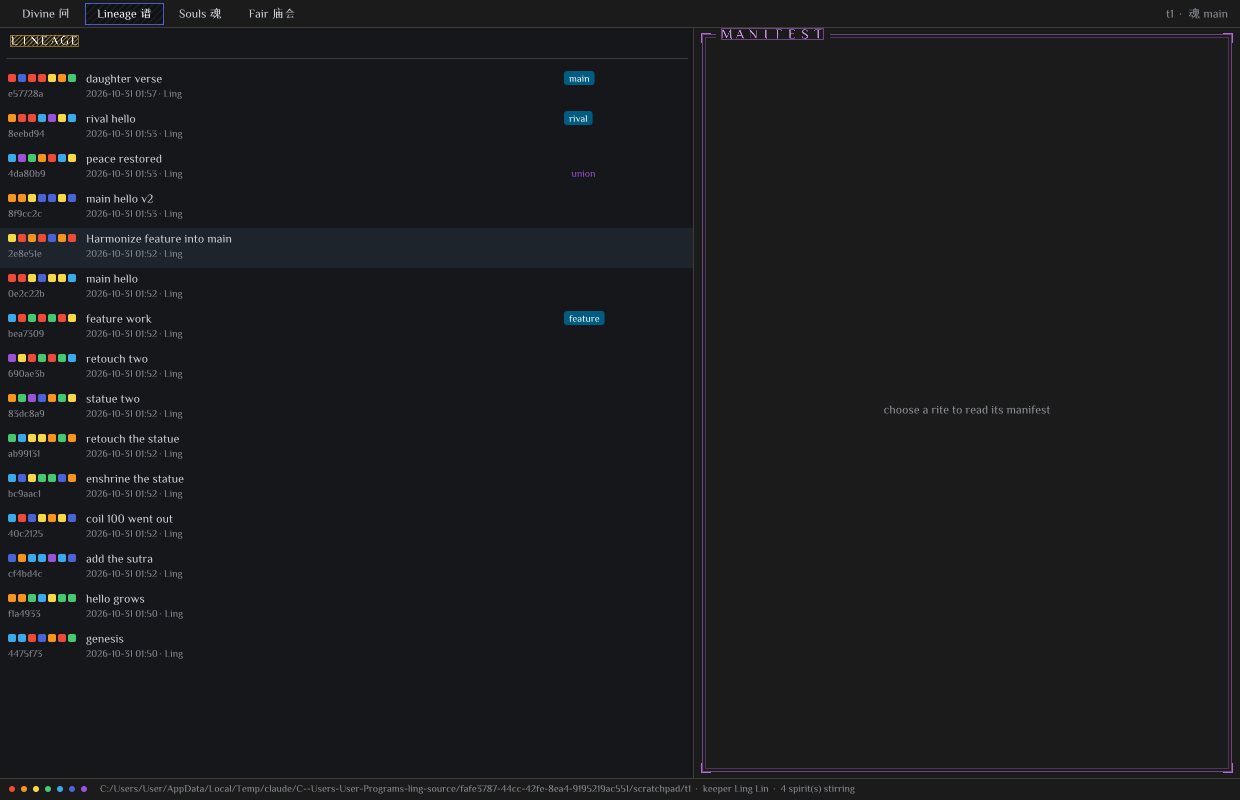
red errors/deletions/discord · orange warnings/restless spirits · yellow the altar · green additions/success · blue souls/info · indigo rite ids/metadata · violet talismans/wandering spirits. Every rite gets an aura — its 7-char short id rendered rainbow in the CLI, seven colored tiles in the GUI.
The GUI — LingMiao
miao gui (or LingMiao.bat). Built from the same design system as LingStationX / LingDev / LingModeler (theme.ling, core.ling, ds.ling, icons.ling): egui-dark chrome, hatched tabs with corner brackets, tile-letter headers. Tabs: Divine (stage/unstage by double-click, live yinyang pane, seal rites), Lineage (auras, soul chips, per-rite manifests with storage glyphs, summon), Souls (kindle, summon, harmonize, release), Fair (open/close the SSH fair inside the window — it serves pilgrims from the frame loop — plus pilgrimage/tribute buttons). F5 re-divines; Ctrl+Q quits. The window narrates every ceremony to the terminal it was launched from.
LingOS
Three integrations, shaped to what lingfs can actually hold (32 entries/dir, 4096 objects) and what kernel .ling can actually do (no binary reads):
- The prompt —
lshshows a zsh-style segment when the cwd holds a shrine:(miao:main +)— violetmiao:, cyan soul name, yellow+when the altar holds offerings. The help screen is color-grouped,rainbow [words]paints text across the VGA rainbow, and unknown commands answer in the temple's voice. - The traveling shrine (行宫) in
lsh— a nativemiaocommand in the text-mode kernels:kai · wen · gong · ji · pu · hun · zhao(init/status/add/commit/log/ branch/checkout, same aliases, ROYGBIV VGA output). History lives in a handful of files — an append-only book of rites with hash-dedup of unchanged files — instead of per-object files. Text spirits only. os/miao_os.ling— the same shrine (identical on-disk book format, so the two interoperate) as a standalone, arch-neutral LingOS program. It is this spirit'sentry_os, soling build .produces bootable miao images for x86-64 (--platform kernel) and the Raspberry Pi 5 (--platform rpi): booted bare they run a self-demonstration against lingfs and rest. Inside a full LingOS it is a one-shot CLI from the Terminal or Pi shell:ling run <path-to-miao_os.ling> wen ling run <path-to-miao_os.ling> gong sutra.txt ling run <path-to-miao_os.ling> ji the first rite
Rebuild the LingOS kernels themselves (from LingOS/) to get the lsh integration:
../ling/target/release/ling build kernel/x86_64 --platform kernel --out dist
bash live/build-iso-x86_64.sh
The .ling side of these builds (including the patched lsh) AOT-compiles clean; the Rust link stage additionally needs the sibling repos (bring-browser, horizon-browser, ling-messenger, LingDev, LingModeler, ling-wallet) reachable at Programs/ — junctions to Programs/LingApps/ work.
Publishing
lingfu publish from this folder hands the spirit to the ling registry (its build farm builds the targets list). lingfu login first if the registry asks.
Inside .miao/
MIAO                 format marker          SOUL        the living soul (HEAD)
souls/<name>         one tip per soul       talismans/  tags
altar                staged overlay         DISCORD     open merge, if any
relics/rite/<id>     rites (commits)        chronicle   reflog
relics/spirit/<id>   per-version manifests (whole|delta|chunks)
relics/pay/<id>      raw payload bytes, BLAKE3-named    mothers / mtips   remotes & their tips
.miaoignore (plus any ling.ignore) controls what counts as a spirit; .miao, .git, cache/, screenshots/, .ling-ssh, .ling-build are always ignored.
Building & running
- From source (all platforms):
ling run --interp ling/main.ling <command>— the launchersmiao.bat/miao.shdo exactly this (release exes built byling buildcarry no console on Windows, so the CLI lives on the interpreter like every Ling app'srun.bat). - Distributable:
ling build . --platform win,lin,mac --out distbuilds the portable LingMiao app perLing.toml. - Put the folder on your PATH (or alias
miao), set your name once:miao keeper "Your Name".
Honest limits (v1)
- One process at a time per temple (no lock file yet — don't run two rites at once).
harmonizehas no rename detection; add/delete vs edit clashes keep ours and flag discord rather than guessing.- The SSH fair authenticates by link secret (password auth), not client keys; run fairs on networks you trust or over a VPN/tunnel, and re-open the fair to rotate secrets.
- Tribute transfers the bundle as one message — fine for source trees, not for gigabyte temples.
- History walks are linear-scan; a temple with tens of thousands of rites will want the pack/index pass that is sketched but not built.