ling-wallet
↓ 0 downloadsLing Wallet: a post-quantum privacy-coin wallet, full node and HyperTorus miner for LNG
lingfu install ling-walletREADME
<div align="center">
🪙 Ling Wallet
A post-quantum privacy wallet, full node and miner for LNG — in one app, written entirely in Ling.
post-quantum · private by default · no accounts, no KYC · wallet + node + miner · one language
</div>
[!WARNING] LNG is a new, unaudited, experimental coin. The cryptography is built on standard primitives, but the ring signature and proof-of-work are novel, the network is small, and nothing here has had an external security review. Read [
docs/THREAT_MODEL.md](docs/THREAT_MODEL.md) before trusting it with anything you can't afford to lose.
✨ What makes it different
Most coins were designed before quantum computers were a planning concern, and most wallets are a thin client that trusts someone else's node. Ling Wallet is built the other way around:
| 🔐 Post-quantum from day one | Identities, key exchange and the wallet file use ML-DSA-87, ML-KEM-1024 and X25519 in hybrid — an attacker who records your traffic today still can't read it after quantum computers arrive. |
| 🥷 Private by default | Every payment uses a fresh one-time address, a ring signature over same-value decoys, and fixed denominations. There is no "transparent mode" to forget to turn on. |
| 🧅 Network privacy built in | Dandelion++ hides which node made a transaction, frames are padded with cover traffic, and all outbound traffic can go over Tor with no DNS leaks. |
| 🏠 You are the node | The app is a full node. It validates the whole chain itself — it never asks a server for your balance, so no one learns your addresses by watching your queries. |
| ⛏️ Mine from the same app | A background miner runs on spare cores, visualized as a 4-D HyperTorus walk. No pool, no separate software. |
| 🧬 One language, no C | Node, wallet, miner, UI and tests are all Ling. The whole thing is readable top to bottom, with no foreign-function glue. |
🆚 How it compares
An honest comparison. Ling Wallet leads on design — post-quantum security and privacy that's on by default — while established coins lead on maturity: they are audited, have huge anonymity sets, and have survived years of attack.
| Bitcoin | Monero | Zcash | 🪙 Ling Wallet / LNG | ||
|---|---|---|---|---|---|
| Private by default | ❌ transparent | ✅ always | ⚠️ opt-in (shielded) | ✅ always | |
| Post-quantum | ❌ ECDSA | ❌ Ed25519 | ❌ | ✅ hybrid PQ | |
| Hidden recipient | ❌ | ✅ stealth addrs | ✅ shielded | ✅ one-time keys | |
| Hidden sender | ❌ | ✅ ring sigs | ✅ zk-SNARKs | ✅ lattice ring sigs | |
| No trusted setup | ✅ | ✅ | ⚠️ (historically) | ✅ | |
| Built-in full node | ⚠️ separate | ⚠️ separate | ⚠️ separate | ✅ in the app | |
| Built-in miner | ❌ (pools) | ⚠️ separate | ❌ | ✅ in the app | |
| Tor / Dandelion++ | ⚠️ add-on | ✅ | ⚠️ partial | ✅ built in | |
| Accounts / KYC | none | none | none | none | |
| Supply cap | 21 M | ∞ (tail) | 21 M | 21 M + tail | |
| Maturity | 🟢 battle-tested | 🟢 audited | 🟢 audited | 🔴 experimental, unaudited | |
| Anonymity set | 🟢 huge | 🟢 huge | 🟡 medium | 🔴 small (new) |
The honest summary: if you need proven, audited money today, use an established coin. If you want to see what a wallet looks like when post-quantum security and default privacy are the starting point, not a retrofit — and you treat it as the experiment it is — that's Ling Wallet.
🛡️ The security stack
Every layer, and whether it's a vetted standard or something new:
┌─────────────────────────────────────────────────────────────────────┐
│  🔑  IDENTITY & SIGNING      ML-DSA-87  (FIPS 204)          [standard]│
│  🤝  KEY EXCHANGE            X25519 + ML-KEM-1024 (FIPS 203)[standard]│
│  🔒  ENCRYPTION              XChaCha20-Poly1305             [standard]│
│  🧂  PASSWORD → KEY          Argon2id  256 MiB · 3 passes   [standard]│
│  #️⃣  HASHING                 SHAKE256 (SHA-3)               [standard]│
│  🥷  SENDER PRIVACY          LRS-87 lattice ring signatures [experimental]│
│  🧅  NETWORK PRIVACY         Dandelion++ · padded frames · Tor        │
│  ⛏️  PROOF OF WORK           HyperTorus memory-hard walk    [novel]   │
└─────────────────────────────────────────────────────────────────────┘
   standard     = NIST-standardized or widely vetted
   experimental = research-grade, flagged in the UI
   novel        = designed here; a flaw can at worst speed up mining
The About page inside the app lists every one of these with its status, and [docs/THREAT_MODEL.md](docs/THREAT_MODEL.md) spells out exactly what each does and does not protect — including a known sender-tracing leak and its mitigation.
🏗️ How the app is built
The UI never touches keys or the network. Each job runs in its own isolate (a sandboxed thread) with only the capabilities it needs, and they talk over channels:
graph TD
    UI["🖥️  UI thread<br/>windows · input · drawing<br/><i>no capabilities to keys</i>"]
    W["🔑  walletd isolate<br/>keys · scanning · signing<br/><i>caps: keys, db, fs</i>"]
    N["🌐  node isolate<br/>chain · mempool · P2P<br/><i>caps: db, fs, p2p</i>"]
    M["⛏️  miner isolates ×N<br/>one per core<br/><i>no capabilities</i>"]
    NET(["🧅  LWP-1 network<br/>peers · Tor"])

    UI <-->|"requests<br/>(wiped channel)"| W
    UI <-->|status| N
    W <-->|"tip · submit · bundles"| N
    N <-->|templates| M
    M -->|solved blocks| N
N <-->|encrypted frames| NET- The node holds
p2pbut neverkeys— a network attacker who found a bug in it still can't reach your spending keys. - The wallet holds
keysbut neverp2p— it never talks to the internet. - Miners get no capabilities at all.
- The UI asks the wallet for things over a separate, wiped channel, so passwords and seed words don't linger.
📸 A look inside
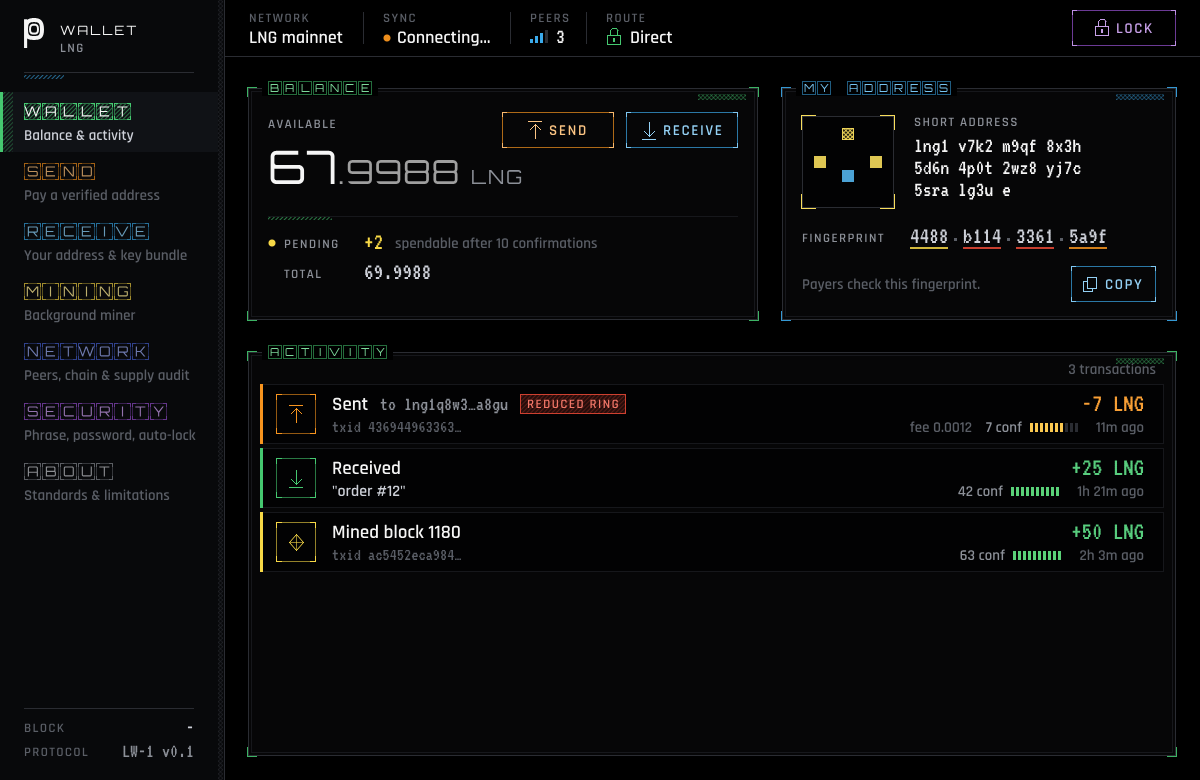
| Balance & activity | 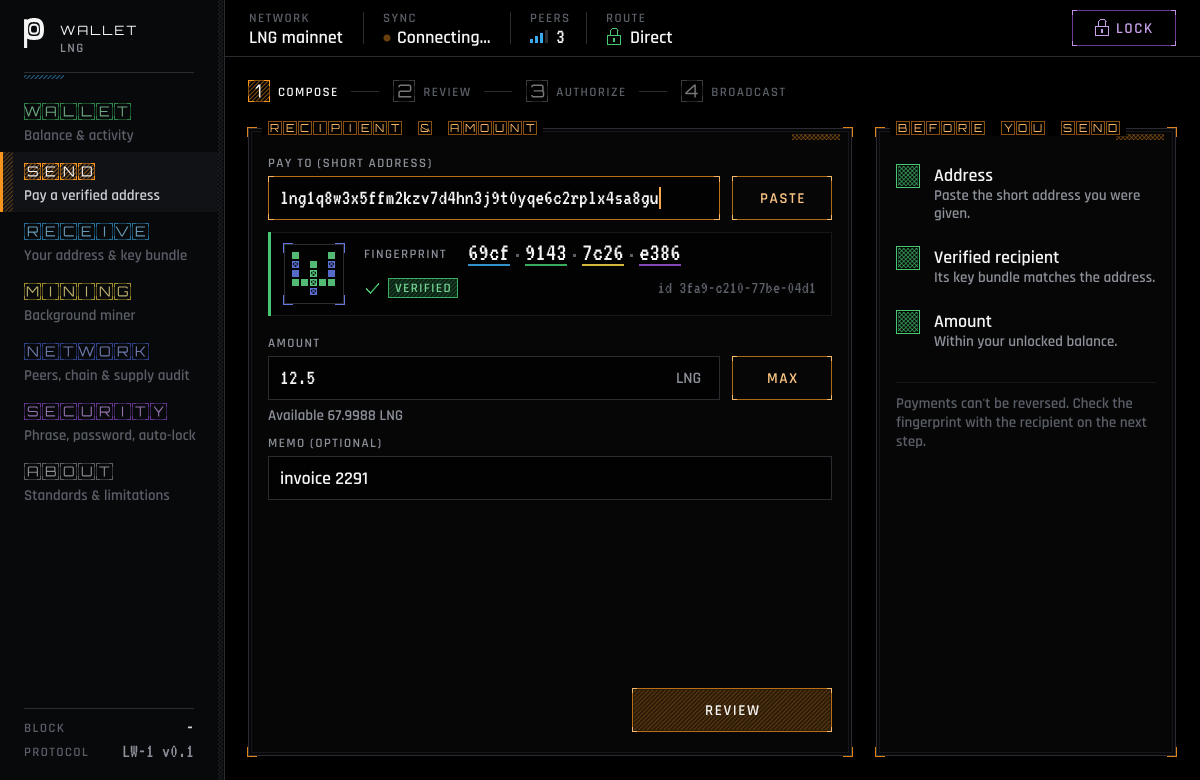 Send to a verified address | 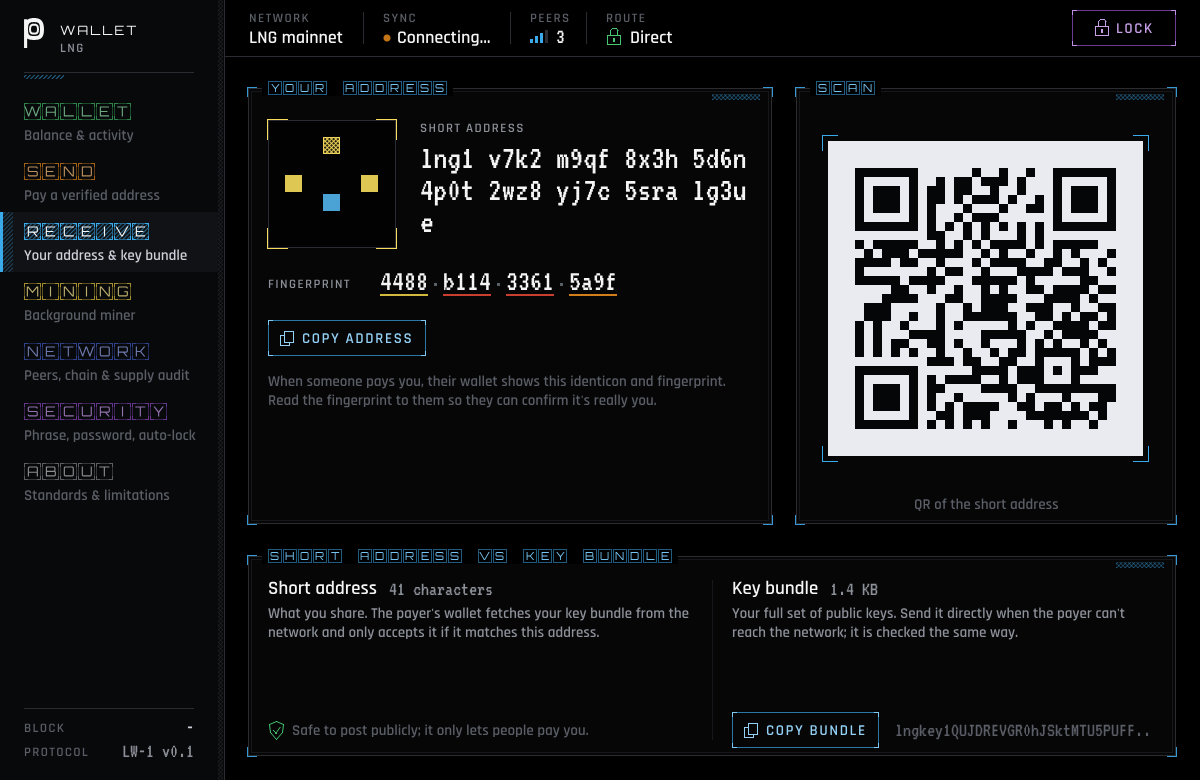 Your address & QR |
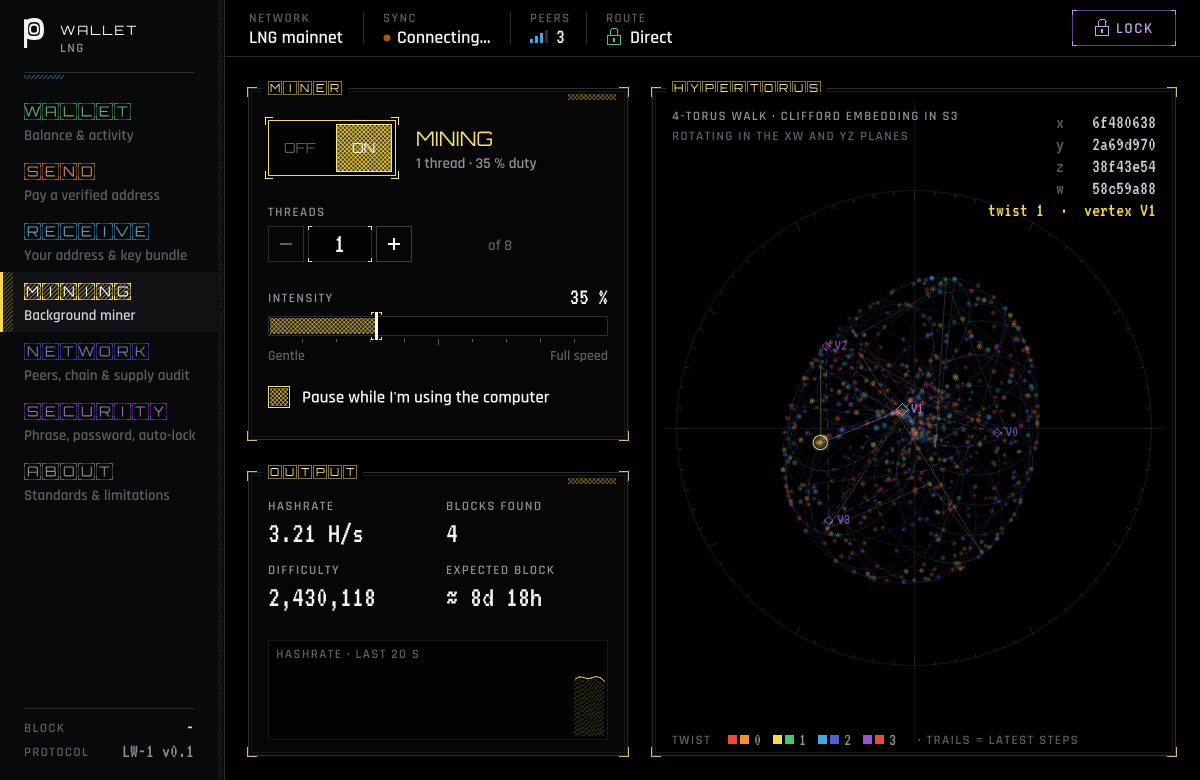 HyperTorus miner | 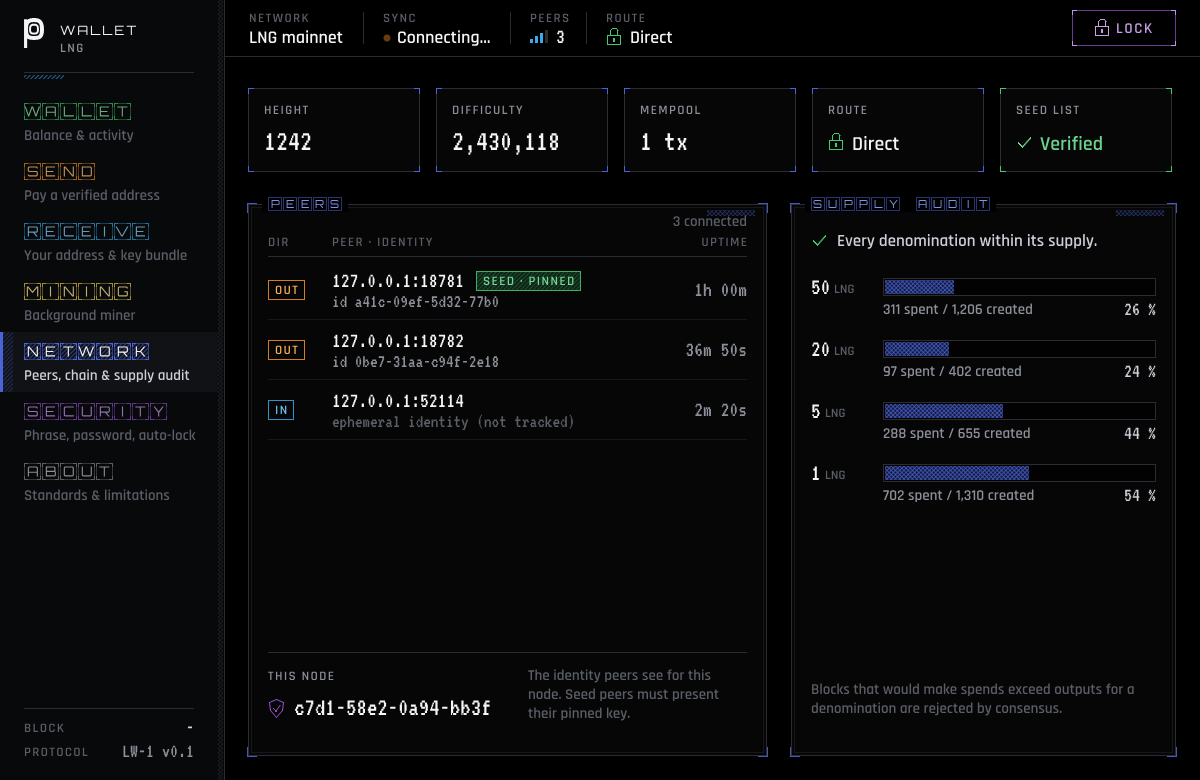 Peers & supply audit | 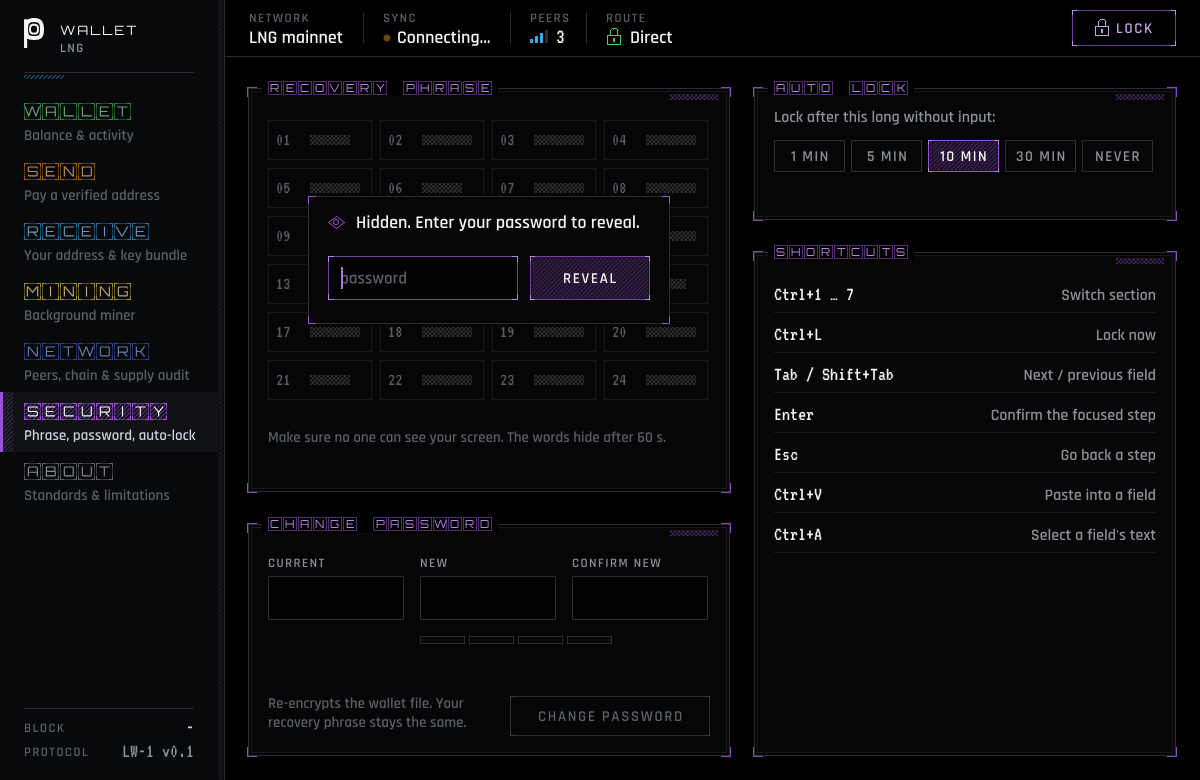 Phrase & auto-lock |
🚀 Quick start
Ling Wallet runs on the Ling runtime — one build gives you both ling and the lingfu package tool.
cd ../ling && cargo build --features web          # once (builds ling and lingfu)
cd ../ling-wallet
lingfu run            # live node — connects to the network and syncs
lingfu run --mock     # simulated backend — no network, for a look around
lingfu run reads entry from [Ling.toml](Ling.toml) and runs ling/main.ling. Any flags after run are passed through to the wallet:
| flag | default | meaning |
|---|---|---|
--data-dir D | %APPDATA%\LingWallet\mainnet | wallet file, chain database, peer data |
--listen HOST:PORT | 0.0.0.0:18780 (none with --proxy) | where this node accepts peers; none = outbound only |
--peer HOST:PORT | — | a peer to connect to (repeatable) |
--proxy 127.0.0.1:9050 | — | send all connections through Tor / SOCKS5 |
--mock | — | simulated backend (UI development, screenshots) |
Your 24-word recovery phrase is your wallet — write it on paper, store it safely, and never photograph it. Keys never leave your computer.
🌐 Running on a real network
Nodes find each other through seeds: always-on nodes listed in a file signed by the seed authority (keys/seed-authority.key, whose public key is compiled into every wallet). A tampered list is ignored. Once connected, nodes gossip the other reachable nodes they know, so a wallet needs only one working seed.
1. Run a seed node on a machine with a public IP or DNS name (a VPS, or a home PC with TCP 18780 forwarded), and open TCP 18780 in its firewall:
ling run ling/seednode.ling --data-dir /srv/lng --mine 2 --pay-to @payout.txtIt writes its identity public key to /srv/lng/node_identity.pub. --pay-to is where block rewards go — a wallet's key bundle (Receive → Copy bundle, the lngkey1… text) or @file holding it. Without one, --mine does nothing. The node remembers the address, so later starts can drop --pay-to.
2. Sign a seed list naming it (on the machine holding the authority key):
ling run ling/tools/seeds.ling sign --authority keys/seed-authority.key \
    --out ling/assets/seeds.lwseeds seed.example.org:18780=@node_identity.pub
ling run ling/tools/seeds.ling show ling/assets/seeds.lwseeds
3. Ship it. ling/assets/seeds.lwseeds goes out with the wallet, and every wallet installs it into its data folder on start when it's newer. A wallet with a seed list needs no --peer.
💡 A home IP can change — give the seed a DNS name and sign the list with that, so an IP change only needs a DNS update, not a new list in every wallet. Wallets behind a router need nothing forwarded (they connect out); forwarding the port only makes a node reachable so it can help relay.
⚠️ Honest limitations
This is where an experiment differs from money you'd rely on:
- No external audit. The code has had internal review (see [
docs/THREAT_MODEL.md](docs/THREAT_MODEL.md)) and nothing more. - Novel crypto. The LRS-87 ring signature is research-grade and has had no independent cryptanalysis. There is a known sender-tracing leak: whoever paid you can tell when you later spend those exact coins — churn coins from parties you don't trust.
- Small anonymity set. Ring signatures hide you among others holding the same denomination; while few people use LNG, there are few to hide among. The wallet flags "reduced ring" spends.
- Visible amounts. Each output is a public standard denomination (post-quantum hidden amounts aren't practical yet); a payment's total isn't linked, though.
- Malware is out of scope. If someone controls your computer, they can read keys as you type. Use a dedicated, encrypted, up-to-date machine.
📁 Layout
ling/
  main.ling            window + frame loop
  backend.ling         be_* contract → real_backend.ling or mock.ling
  real_backend.ling    spawns and talks to the isolates below
  seednode.ling        headless seed node for a server
  isolates/node.ling     chain, mempool, P2P      (caps: db, fs, p2p)
  isolates/walletd.ling  keys, scanning, signing  (caps: keys, db, fs)
  isolates/miner.ling    one per core             (no capabilities)
  core/                consensus: params, codec, money, chain, mempool, wallet
  ui/                  screens, widgets, theme, HyperTorus visualizer
  tools/seeds.ling     node identity · sign / show seed lists
  tests/               crypto, threads, p2p, chain, nodes test programs
  selftest.ling        drives the real backend end to end
docs/ DESIGN (consensus spec), THREAT_MODEL, LING_API, LING_BACKEND🧪 Tests
cd ling/tests/crypto  && ling run --interp t_crypto.ling   # 204 checks
cd ling/tests/threads && ling run --interp t_basic.ling    # 72
cd ling/tests/p2p     && ling run --interp t_p2p.ling      # 71
cd ling/tests/chain   && ling run --interp t_chain.ling    # 19: mine, send, double-spend, reorg
cd ling/tests/nodes   && ling run --interp t_nodes.ling    # 7: two nodes sync over P2P
cd ling && ling run --interp selftest.ling --data-dir <empty dir> --fast-kdf 1 --listen 127.0.0.1:18795   # 22
<div align="center">
Built with Ling · MIT license · an experiment, not a bank
*Read [docs/THREAT_MODEL.md](docs/THREAT_MODEL.md) before you trust it.*
</div>